News
How technology can break language barriers What superpower would you like to have? The most common answers, invariably, fall into clichés: flying, being able to become invisible, having super strength... But have you ever imagined being able to communicate with anyone, anywhere in the world, speaking their own language? It sounds like the stuff of super-geniuses or science fiction. However, technology is already advancing to resolve this linguistic impasse. According to Ethnologue, considered the largest language inventory in the world, there are nearly seven thousand languages in use. It also considers where they are spoken and how many people speak them. When we think of a universal language, English immediately comes to mind, but the most widely spoken language in the world is Mandarin, with around 870 million people using it. In second place is Hindi, and in third is Spanish; English appears in fourth place and Portuguese in seventh. With this immense linguistic variety, and considering that Ethnologue does not cover 100% of the world's languages and dialects, it is humanly impossible to be able to speak all of these languages. In fact, this ability to speak multiple languages is called hyperpolyglotism, attributed to people who master more than 11 languages. Technically, there is no proven limit to the number of languages a person is capable of learning. However, knowing a language is different from mastering it, and the criteria for defining this mastery are highly subjective. Therefore, it is difficult to determine who is the person capable of speaking the most languages in the world. It is debated that the greatest hyperpolyglot who ever lived may have been an Italian monk who lived between the 18th and 19th centuries, allegedly speaking more than 100 languages and dialects fluently.
Speak with one of our specialists and discover how Pix Force can transform your business
How to decipher the labyrinthine, bottomless pit of meanings?
Everyone with internet access knows Google Translate. Although it is not the only translation tool in existence, Google Translate has been reinventing itself. There is much criticism of its inability to provide a translation that wasn't laughably literal. This type of poor translation is more common in lesser-known languages, mainly because the translation is not direct. First, the tool translates the source language into English, and only then does it translate into the desired language. With so many translation processes, a lot is inevitably lost, especially the essence of meaning, and the last resort is to try to translate literally. It is thanks to this multiple essence of meanings, which can vary according to context, intonation, or a variety of other variables, that languages are so rich and complex. In short, mastering a language, that is, being fluent, is the ability to communicate with ease, clarity, and as naturally as possible. All of us born in Brazil are fluent in Portuguese, our official language. However, there are many variations that create barriers in communication, such as heavy accents and words that differ from place to place. An example is the famous "biscoito" vs. "bolacha" debate or "Nordestinês" (Northeastern Portuguese), with its wealth of expressions. Not to mention the variations of Portuguese used in other Lusophone countries and regions, such as Portugal, Angola, Mozambique, and Galicia.
And what does technology have to do with it?
It is a challenge for translators, both human and technological, to try to capture the essence within this infinite range of variations of meanings in a language. Therefore, good translation takes time and dedication to be done. The goal is to preserve the original meaning as much as possible, so the adaptation to the target language is fully successful. In the early moments of Artificial Intelligence, computers only mechanically obeyed what programmers dictated through command codes. When Artificial Intelligence was perfected through Machine Learning, systems could "learn" on their own through patterns and contexts to calculate the best possible translation. Still, the model was too rudimentary. It got the job done, yes, but there was plenty of room for improvement. That was when, starting in 2016, Google began using artificial neural networks. In short, artificial neural networks were designed to simulate the human neural network. They carry information to the brain (in this case, Artificial Intelligence) at a much faster speed and with much more data than the human brain is capable of. These artificial neural networks are based on two different methods: Deep Learning and representation learning. Each is applied to try to represent the full functioning of human reasoning when communicating in their native language. In this way, unlike statistical translation systems (such as the early versions of Google Translate), the machine is able to discern between different degrees of abstraction in a context. Various aspects of the required situation as a whole are evaluated to put together the translation puzzle, considering many more nuances and variations.
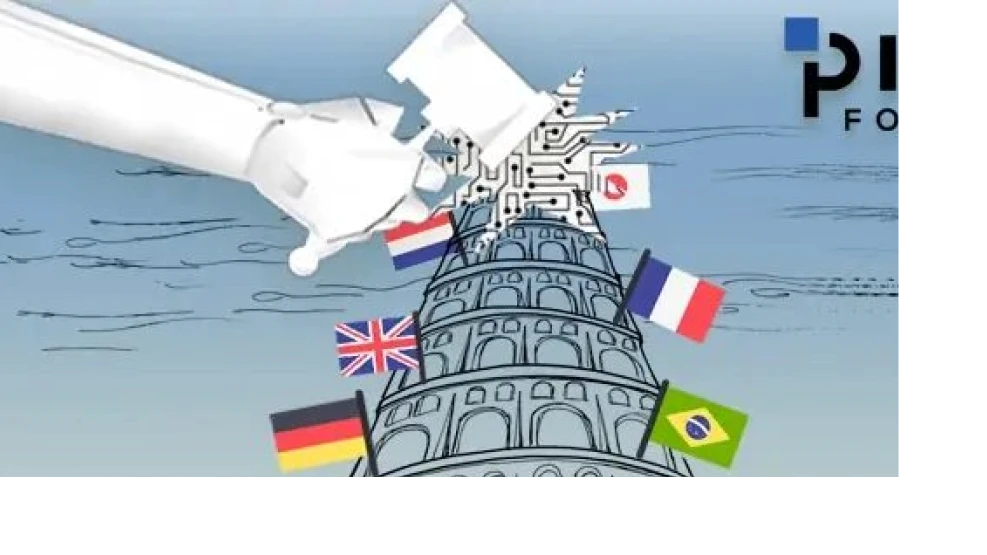
So, will the Tower of Babel fall?
It is difficult to predict the future, especially when the debate invariably devolves into extremist visions where the world is dominated by machines and the human factor is disregarded. But the people at Google say no. Communication and human language are much more complex than what translation systems aim to be. Tools like Google Translate (and so many others!) are merely means to facilitate this more complex interaction. It depends on emotion, body language, and many other cultural and subjective factors that are exclusively human. It is precisely this infinite repertoire of human particularities, such as cultural differences, that prevents machine translation systems from being definitive replacements for professional human translators. Despite the speed and quality of automated translation, it is still necessary for a human to review the content and look for nuances that the system is unable to detect, such as linguistic variants and current usages. Even within Portuguese itself, we find this impasse. Some words that are completely banal and everyday for the Portuguese of Portugal are very vulgar and offensive swear words for Brazilians. Others have fallen into disuse and are considered extremely archaic. Can the system evaluate this bias that is so subjective and so full of historical and cultural weight?
Desafios, challenges or retos*?
Another important issue is the imposition of one language over another. Most of the fully accessible content production on the internet is in English and other “large” languages, such as French, Spanish, and German. Therefore, for more restricted languages, such as indigenous and tribal dialects, direct translation is precarious. The only way is to perform an indirect translation. This means translating the source language into English and, from there, translating it into the target language. This situation privileges the online imperialism of these “large” languages in a self-feeding system. Let's say you are a Galician who wants to write to the world about your customs. Since there is little content in Galician (compared to sister languages, Portuguese and Spanish), translation tools will not be able to capture everything you want to convey, and much will be lost in machine translation to Portuguese or Spanish. So, it is better for you to write in one of these languages right away so that the translation is more complete and richer.
I want a machine translation gadget for yesterday!
There are already headphone options that offer simultaneous translation, but they are still not very accessible (both in terms of price and in terms of variety of languages). However, these gadgets are good resources. Their technology has already been improved to recognize accents and reduce background noise interference in noisy environments. Although still in the development process, the technology applied in overcoming language barriers already helps us to form connections and expand communication. The ability to learn languages can be considered a gift, in addition to a privilege that is not achievable by all layers of a population. Perhaps it will never be possible for a "Babel fish" to exist. The character created by Douglas Adams in the "Hitchhiker's Guide to the Galaxy" knows all the languages of the universe and allows for clean and reliable communication. Even so, technology always reinvents and improves itself to get as close as possible to the unimaginable: promoting perfect communication between people who do not know each other's language.
Fabio Caraça
Fábio Caraça is the Chief Growth Officer at Pix Force. He leads Pix Force's transformation into a scalable SaaS operation, combining strategic vision, culture, and high-impact execution.