News
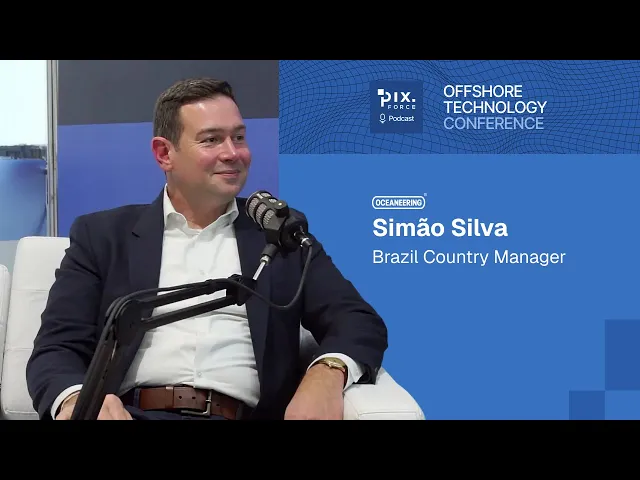
The search for efficiency, safety, and compliance is the strategic focus of any highly complex industry. At the Offshore Technology Conference (OTC) in Rio de Janeiro, we gained access to crucial insights about the future of the sector on the Pix Force Podcast, recorded during the event.
In a conversation with Simão Silva, Country Manager of Oceaneering in Brazil, we discussed how the Oil & Gas sector balances the need to innovate with disruptive technologies while simultaneously ensuring the operational efficiency of its activities.
Speak with one of our specialists and discover how Pix Force can transform your business
Oceaneering's Innovation Model
Oceaneering adopts a vanguard strategy, positioning itself as a Technology Delivery Company. Its innovation philosophy is clear and client-focused, as commented by Simao himself:
“Our number one priority is not to make art, it is not to do research. We do a little bit so that [Oceaneering] remains at the forefront of technology… But our main objective today is the identification of technologies that are on the market and can be added to our portfolio and that increase value generation for our end client.”
Oceaneering's innovation model is based on partnerships, seeking companies that can develop the technology, and focusing on execution and service delivery.
The Digital Twin
The future of safety and inspection is focused on removing the human factor from high-risk environments. Oceaneering exemplifies this strategy with the acquisition of GeoSLAM.
The core insight of this technology is the creation of the “Digital Twin” from the scanning of the real asset, and not just from the design, recognizing the modifications that occur over 10 to 40 years of operation.
This technology points directly to the future, with a focus on having fewer people in high-risk areas.
“In a not-so-distant future, you won't need to have people running all over the platform doing scanning… You will have a robot walking around the platform… And then you will have a person who will only look at the anomaly. So you manage based on the exception and no longer manage based on the inspection of the entire package…” — Simao Silva.
Impact of AI on the worker's daily life
The impact of Artificial Intelligence and robotics in the work environment is already tangible and translates into a clear ROI.
An internal case from Oceaneering illustrates the acceleration of processes: two engineers dedicated an entire month to the manual review of offshore reports. One of them created an automation for checking deviations, reducing the working time to just 30 minutes.
AI eliminates manual inspection and frees the team to focus on more strategic actions.
The conclusion is a market expansion: technology creates new opportunities in all markets, causing the expansion of these sectors and their technologies.
The Innovation Dilemma in Oil and Gas
Brazil stands out globally for its potential in technology development. The Oil & Gas sector is fueled by an innovation engine of monumental scale, about which Simao comments the following:
“There is an investment fund fostered by the ANP through regulation, which obliges oil and gas producing companies to dedicate a portion of this money and 1% of their net profit to research funds. And today this money totals an approximate amount of 3 billion dollars per year available to the industry.”
Despite the magnitude of the capital, Oceaneering points to the challenges of access. Most of this capital is directed toward universities, while the problems that require R&D investment start in operations.
“The cool thing is that I think Brazil fits very well at the intersection of these three points. So, despite this, we still don't develop much technology in Brazil due to the bureaucratic obstacles to accessing this technological [fund].” — Simao Silva, Brazil Country Manager at Oceaneering.
Solution to a Real Problem
Simão Silva concludes the conversation with a powerful reflection that should guide any B2B technology company: avoid developing things that do not solve a real industry problem.
“I can see that countless operators in Brazil and around the world have developed technologies that are useless… they have zero practical commercial application.”
According to Silva, the focus must be on eliminating concrete pain points:
“The first reflection is the problem I am trying to solve and, based on that, building your solution development case around eliminating a problem that will generate value for the industry…”
The takeaway insight is that innovation is about developing solutions that solve real problems and generate measurable value for operations, rather than just chasing the latest trends.
Conclusion: The Path to the Future of the Industry
Oceaneering's vision provides a clear roadmap for the role of B2B technology in Brazil: successful innovation is that which solves a customer's problem and generates practical and economic value.
Pix Force, with its AI and Computer Vision solutions, is fully aligned with this vision: optimizing safety non-compliance inspections and increasing the safety of operations.
Watch the full episode on YouTube.
Want to know more about Pix Force's solutions? Get in touch through the form on our website.

Fabio Caraça
Fábio Caraça is the Chief Growth Officer at Pix Force. He leads Pix Force's transformation into a scalable SaaS operation, combining strategic vision, culture, and high-impact execution.