News
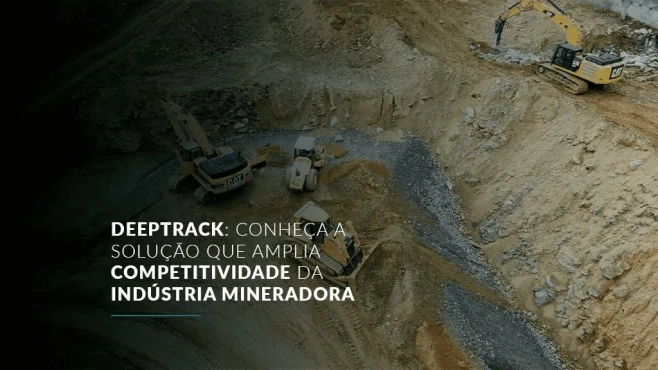
A fundamental activity for modern life, mining as we observe it today has only been possible thanks to the application of technologies capable of reducing damage. Allied in the execution of risky work, innovation has become a key element for the industry to become safer and more effective. This is the case with Deeptrack, a solution developed by Pix Force capable of bringing more safety, precision, and agility to the inspection of conveyor belts operating in the sector's logistics. Through Artificial Intelligence (AI) applied to computer vision, Deeptrack introduces drones to the inspection of transport carried out by belts, overcoming human capacity to perform the task. The aircraft equipped with infrared and RGB sensors are capable of pinpointing the individual temperatures and georeferenced location of each roller, preventing overheating and consequent operation halts. Deeptrack allows image capture to be performed more precisely and effectively than human vision, generating reports that will later be evaluated by the team responsible for the logistical operation. With the help of computer vision, maintenance technicians have the opportunity to work on predictive maintenance, reducing risks to the logistics chain and consequent financial losses. Extraction and inventory costs are directly linked to the efficiency of the conveyor belts, which need to travel long distances before the raw material reaches its destination. Problems along the route can generate financial losses that reach up to $1 million if unexpected stops occur, not to mention the subsequent decrease in market competitiveness. A survey conducted by one of the companies served by Pix Force pointed out that defective rollers are among the greatest causes of failures in conveyor belts. Not to mention that, of the 325.5 hours that the belts remained idle, 169 were linked to fire outbreaks, a factor directly related to the overheating of the rollers. The adoption of innovative solutions plays a fundamental role in solving the main problems faced by the industry. According to research developed by the National Confederation of Industry (CNI), 83% of companies will need to apply more innovation if they want to grow or even survive in the post-pandemic world. The same survey reported that one in three managers believes that the national industry will need to take a leap in innovation over the next five years to ensure business sustainability.
Speak with one of our specialists and discover how Pix Force can transform your business
Companies that do not open up to innovation lose market share
The result of the mining process is much more present in daily life than one might imagine. Airplanes, cars, and computers are some of the products that require mining activity to be manufactured, not to mention the relevance of extraction for the construction of houses, buildings, and roads. However, the lack of openness to the introduction of new technologies in mining can pose serious risks to the industry's competitive capacity. This is the case with the logistical complexity involved in transporting supplies. Technical problems can be responsible for inestimable losses, ranging from repair expenses to serious health risks for the workers involved. Solutions like the one developed by Pix Force are capable of making the production chain more efficient and secure, reducing costs and increasing the sector's competitiveness.
Reduction of risks for workers
Safer working conditions are another advantage brought by the incorporation of new technologies. Every 48 seconds a worker suffers an accident in Brazil, according to the Digital Observatory of Health and Safety at Work of the Public Ministry of Labor (MPT). In mining, the rate of work accidents is higher compared to the entire industry, according to information from the Brazilian Mining Association (IBRAM). The reality faced by human labor draws attention to the need to replace manual labor in high-risk operations. Deeptrack follows the flow of transformation, surpassing human capacity in identifying overheating in rollers that make up conveyor belts. In addition to being expensive and time-consuming, manual monitoring of belts is a process that poses serious risks to the life and health of workers, who must face severe working conditions in hostile environments to perform inspections. With the application of Pix Force's technology, the process gains agility and efficiency, as well as reducing operation costs. If image capture and analysis was once known as an expensive and difficult-to-access process, the reality employed today is very different. Adopting the technology has already proven to be cheaper and more viable than using human labor, not to mention that the teams involved can shift their focus to predictive maintenance.

Fabio Caraça
Fábio Caraça is the Chief Growth Officer at Pix Force. He leads Pix Force's transformation into a scalable SaaS operation, combining strategic vision, culture, and high-impact execution.