News
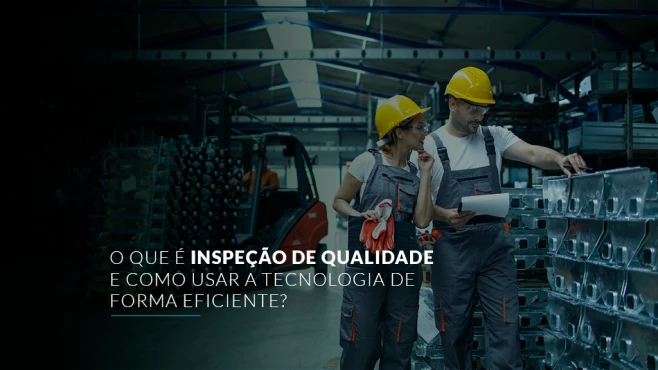
Quality inspection is a procedure aimed at ensuring that the product meets various quality criteria based on the requirements requested by the customer. Therefore, many companies include a quality inspection in their production routine. In general, quality inspection ensures the product's compliance with: • Customer expectations;
• Market requirements;
• Standards and legislation;
• Company specifications.
Generally speaking, quality inspection is carried out by the company's team, which checks the raw materials used in the product design, as well as the production in progress and the finished product, before it is offered for sale. But this process can be done faster and more efficiently through technological solutions that use artificial intelligence. Want to know how to optimize quality inspection through technology? Stay with me in this text until the end and understand!
Speak with one of our specialists and discover how Pix Force can transform your business
What are the types of quality inspection?
Quality inspection is the final cycle of the management process. In relation to the objectives set in the plan, the manager verifies, at the end of the fiscal year, the results obtained. They evaluate the progress made and the performance achieved. There are several types of control: • Pre-production inspection: Pre-production inspection ensures that all conditions and parameters necessary for the company's operation are met. Initiated before the launch of the action process, preventive control analyzes the measures implemented.
• In-line inspection: In-line inspection is carried out throughout the entire production process. It makes it possible to monitor achievements in their multiple deployments, verify results, and provide information on the company's operation.
• Pre-shipment inspection: Pre-shipment inspection is essentially carried out at the end of a cycle or a production stage. In relation to the results achieved and the standards established in the plan, the manager makes the corrections they consider essential to better meet, in the current or next fiscal year, the goals set. However, by only intervening at the end of an action process, pre-shipment inspection can sometimes arrive too late or prove to be costly and inefficient.
Therefore, we can differentiate the various types of quality inspection, taking into account the need and importance of each one.
Why perform quality inspection?
Quality inspection is a procedure carried out in the company with the objective of verifying the compliance of a product or service with previously established criteria. This step can be included in the quality approach. Referring to the ISO standard, quality inspection can be defined as a process by which the quality controller examines, measures, and performs tests. The objective is to detect any non-conformity of raw materials or products. Carrying out a quality inspection aims above all to improve the quality of service. Furthermore, it makes it possible to offer a better product to the clientele. • Reduction of production costs;
• Higher customer satisfaction;
• Awareness of each employee and manager about the quality imperative;
• Optimized use of resources.
Therefore, quality inspection should not be improvised. For it to be effective, it is necessary to establish very specific standards. From them, it is easier to tell if the product is non-compliant. In addition, it is also important to determine the number of units to be checked. Thus, the company needs to use reliable and relevant methods so as not to make mistakes that could compromise the company. Therefore, the use of technology in quality inspection is essential. It is possible through cameras and specific computer vision software to capture images that accurately demonstrate product quality and potential defects.
The best solution for your company's product quality
The main element that establishes the quality of a product is, therefore, the need for which it is intended. Product management specialists know, therefore, that it is more relevant to focus on meeting consumer needs than on seeking maximum quality. Maximum quality can, in fact, increase the product cost, raising it to levels unattainable for some consumers. This justifies the interest in the notion of perceived value. An alternative is to analyze how competitors are working and use more modern technological methods in improving your product. But we have an even more efficient solution for quality inspection here: Pix Quality.
Examples of Pix Quality quality control optimization
Pix Force is a company that develops technological solutions, using computer vision, artificial intelligence, and machine learning. The goal of Pix Force is precisely to solve the problems of the most diverse business and industrial sectors through the automatic interpretation of images. To some extent, performing quality control manually is much more time-consuming and subject to operational failures. On the other hand, using Computer Vision with machines capable of performing a complete traceability process, specific failures can be found more quickly and efficiently. Therefore, through artificial intelligence, it is possible to present examples of the efficiency of Pix Force's products. One of the products we offer that presents a definitive solution for quality inspection is Pix Quality. But how does this product work? In fact, Pix Quality can be used in several segments. To exemplify, we can show the functionality of Pix Quality in the quality inspection of stainless steel cutlery. With a technology based on machine learning, it uses an RGB camera and a lighting system to identify scratches, unevenness, or any other defect. A second example of the high technology used by Pix Quality is the specification of reflectance in stainless steel tubes. The modern technology allows for measuring and classifying bidirectional reflectance on stainless steel tube parts. For this, RGB cameras and a diffuse light source are used. Thus, promoting the specification of the parts according to their degree of reflectance. In other words, it is possible to measure the quality of a product more effectively, at lower costs, and in less time through Pix Quality. If you want to know more about Pix Quality and how it can help your company in product quality inspection, fill out the form below and talk to us!

Fabio Caraça
Fábio Caraça is the Chief Growth Officer at Pix Force. He leads Pix Force's transformation into a scalable SaaS operation, combining strategic vision, culture, and high-impact execution.